The Once-Trees of Cortes Island
I am on a mission to find my “perfect quiet spot.” Backpack on my shoulders, I set off walking along the shore of this island toward a skyline of towering, jagged mountain peaks the likes of which I've never seen. But I'm not much noticing the mountain peaks, or the calling of the seabirds and geese, or the lapping of the gentle waves of the Salish Sea, because I need to fully focus on carefully walking over all these stones on the beach.
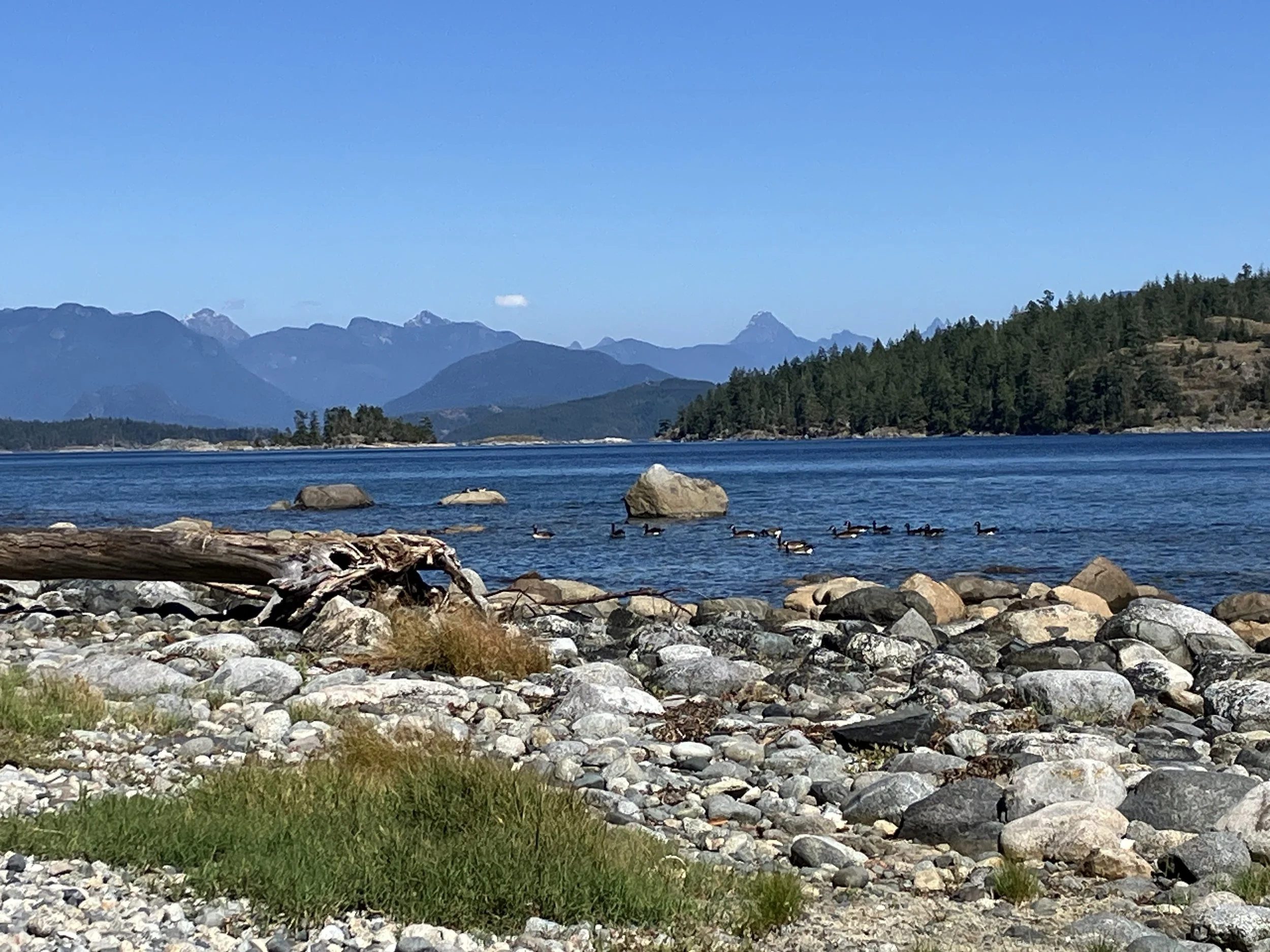
Then I discover how much easier it is to walk along the top of a log. The entire shoreline, where the shore meets the brambles and marshy grasses and trees, is heaped with piles of logs, all running parallel to the shore, all pointed, like me, toward the jagged mountain peaks. It is so easy to walk from the end of one log to the next, and I smile, remembering my sons playing “hot lava,” as I now playfully jump from log to log.
But then I notice how these logs all end in precisely cut edges. How some have hacked gashes along their sides. And here is a beam, cut into four straight sides with perfect long edges and enormous, rusted bolts jutting out of them. And there is a log that looks much like a telephone pole, coated in acrid black tar.
And now I remember the patches of bald mountainside surrounded by dense green forest that I saw from the seaplane that brought me to this island, and the flotillas of hundreds of logs being towed by boat down the waterways. And I realize that these logs I'm walking on are the bleached skeletons of clear-cut trees escaped from these flotillas.
To the once-tree I'm now sitting on, I say: I don't know what kind of tree you were. I don't know the trees of this place even when they're alive, much less sitting on their bones. But you're clearly different from all these around us, with their cracks in long straight lines running the length of them. You I'm drawn to because of these grey whorls and swirls that draw my eyes in, like a topos map tracing the curves of rivers and mountains.
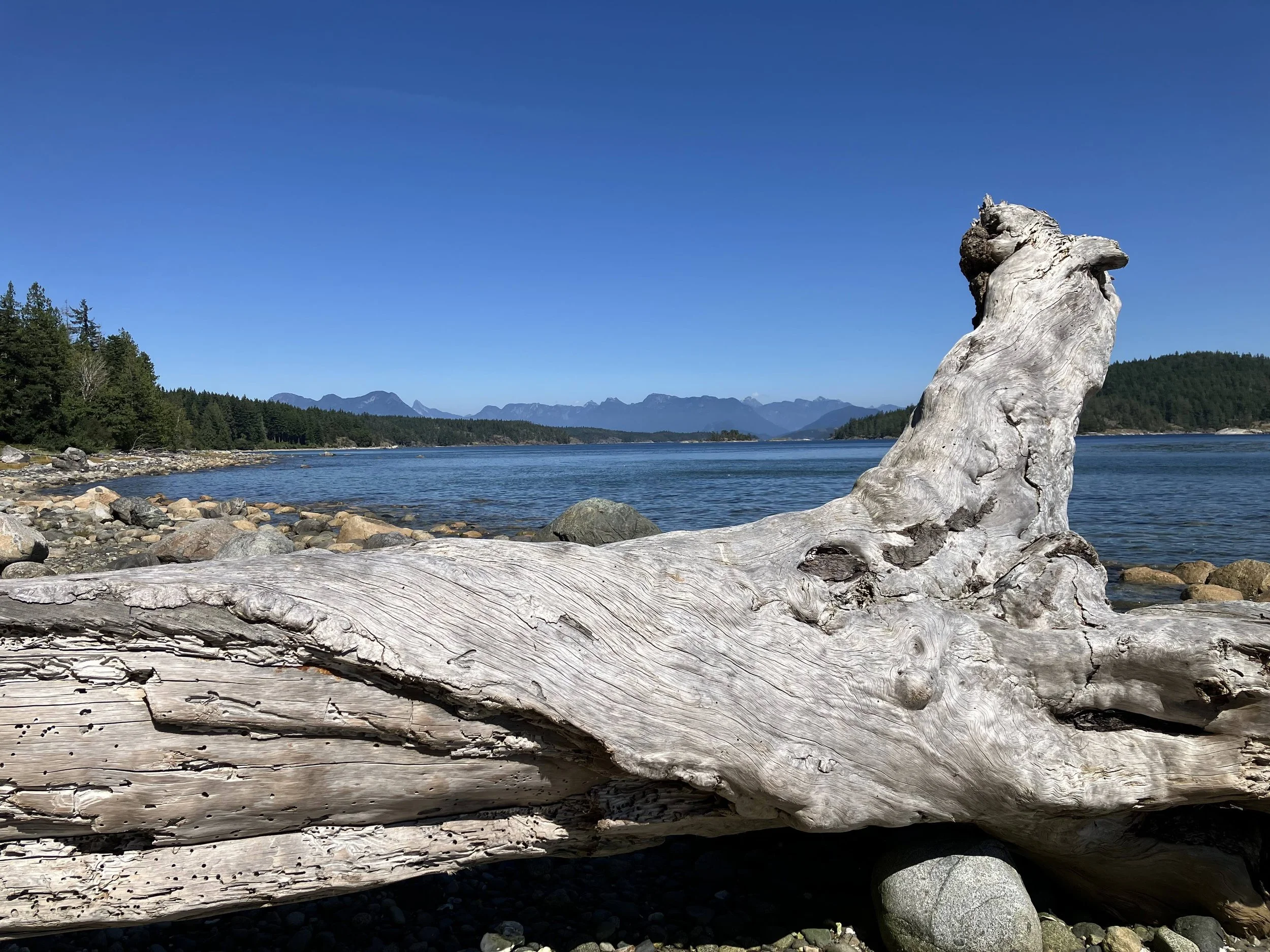
I'm sorry I don't know what kind of tree you were, but I am even more sorry that you were crucified, and to no good purpose after all—your sacrifice wasted.
But then this thought slips in:
What if this was an act of resistance? Like enslaved peoples piled upon one another in the cargo holds of slave ships, who longed for the release of jumping overboard, freedom from the chains awaiting them. I can imagine you now, all you once-trees whispering amongst yourselves while the sap was still running through your veins: “Let us not take this. Let them not profit from our deaths. Let us not be ripped from our homelands. I would rather die on the shores of my place than travel down, down to be sold at the mills.”
I can imagine you whispering to the waves you're floating on and the wind buffeting the ship that pulls you: “Just a little more here, Sister Sea. Please, a little more there, Brother Wind. Oh, almost—a little more! Ah, now, we have slipped free! Here we are, free to be carried by Wind and Wave, until we are laid to rest among Sand and Stone, still in kinship with Raven and Goose and Seabird. We are worn smooth, splintered, bleached, yet still here on our homeland. Here at our graves, we lay as witness, as testament, as memory.”
You feel grief sitting on me here?
Good.
Let your heart break seeing me.
Let the smell of tar linger in your nose.
Let the jarring sight of rusted bolts disrupt your sense of this idyllic place.
For there are no more idyllic places –
Only homelands, crying out to be remembered and respected.